
How Much Fiber You Need: The Forgotten Macro

Updated: 7 hours ago
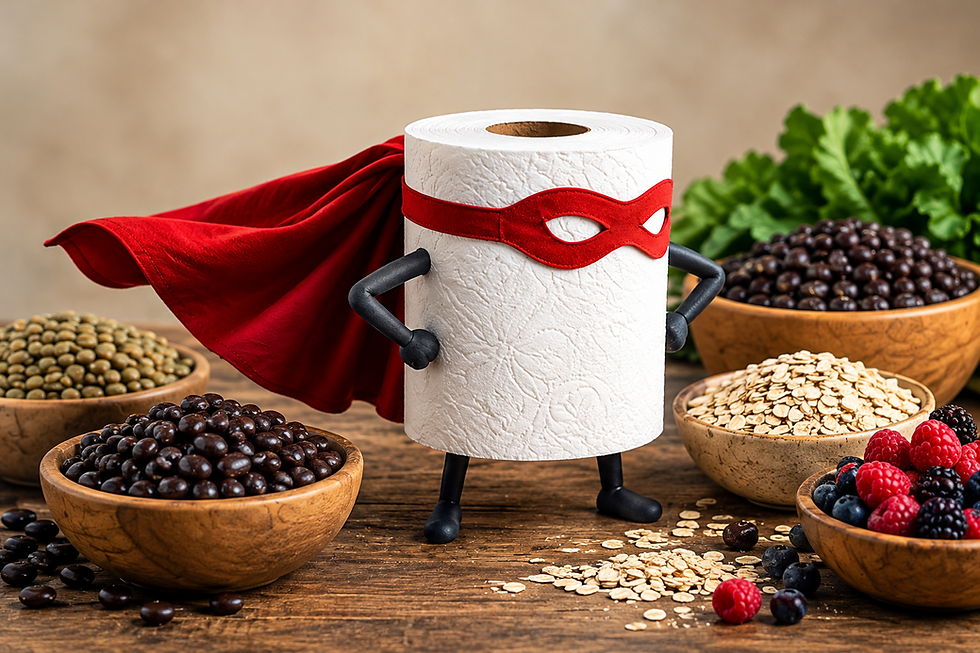
Ask anyone at the gym for their macros and you will most likely get three numbers: Protein, carbs and fat. But fiber rarely gets mentioned, it sits at the bottom of the nutrition label like the kid nobody picked for dodgeball. That is a mistake, because almost nobody can tell you how much fiber they eat, and the research on it is about as close to a sure thing as nutrition science ever gets.
Social media has finally noticed. After a solid year of everyone counting protein grams, TikTok discovered #fibermaxxing (don't even get me started) in 2025 and promptly declared fiber the new protein. For once the internet stumbled onto something true, although it skipped the parts about why fiber works, how much you actually need and why jumping from 12 grams to 50 grams overnight will make you very unpopular in a shared office. Under certain cirumstances this could be a war crime.
How Much Fiber You Need and How Little You Get
The Institute of Medicine set the adequate intake for fiber at 14 grams per 1,000 kcals, which works out to about 25 grams a day for women and 38 grams for men under 50, with slightly lower targets for older adults. An analysis of national survey data from 2013 to 2018 found that fewer than one in ten American adults hit that number, with typical intakes hovering around 16 grams a day. In other words, most people are eating roughly half the fiber they need while arguing online about whether their oat milk is poisoning them. The standard American diets is indeed S.A.D.
What the Research Says Fiber Does
The strongest single piece of evidence is a 2019 series of meta analyses in The Lancet, commissioned to inform World Health Organization guidelines, that pooled 185 prospective studies and 58 clinical trials. People eating the most fiber had a 15 to 30 percent lower risk of dying from any cause and from cardiovascular disease than people eating the least, along with lower rates of heart disease, stroke, type 2 diabetes and colorectal cancer. The biggest benefits showed up at 25 to 29 grams a day, with hints that eating more than that may help even further.
An umbrella review published the year before graded 18 separate meta analyses covering 298 prospective studies, and it rated the link between higher fiber intake and lower all cause and cardiovascular mortality as convincing, the top tier on its scale.
The clinical trials in that same paper add something the observational data cannot, because when researchers actually raised people's fiber intake, body weight, systolic blood pressure and total cholesterol all came down. Fiber also feeds the bacteria in your colon, which ferment it into short chain fatty acids, one of the more plausible reasons it shows up on the right side of so many health outcomes.
NOTE: Most of the mortality data is observational, which means people who eat lentils may also exercise more, smoke less and eat fewer gas station burritos. The researchers graded the certainty of the fiber evidence as moderate, which in nutrition science is roughly the equivalent of a standing ovation, and the trial data on weight, blood pressure and cholesterol point in the same direction.
What the Fiber Skeptics Get Right and Wrong
Every nutrition consensus attracts a contrarian, and fiber has a whole carnivore wing of them. Functional medicine writer Chris Kresser has argued for years that the benefits of fiber are overstated, and his case rests on three main claims that deserve a straight answer rather than an eye roll.
The first claim is that trials adding isolated fiber supplements have not reproduced the benefits seen in observational studies, and that one is partly true. In a large trial published in the New England Journal of Medicine, 13.5 grams of wheat bran a day did nothing to stop precancerous colon polyps from coming back over about three years. The catch is that the same body of trial evidence shows fiber lowering body weight, blood pressure and cholesterol, so the honest conclusion is that sprinkling bran on a junk food diet is not a cancer shield, not that fiber is useless.
The second claim is that high fiber diets cause diverticulosis, the little pouches that form in the colon wall. A colonoscopy study of 2,104 people did find that the highest fiber eaters had slightly more of these pouches, but most pouches never cause a problem, and that study only took a single snapshot. When researchers followed 47,033 people for more than 11 years and counted actual diverticular disease, the kind that lands you in the hospital, the highest fiber group had a 41 percent lower risk!
Yes, you can overdo it fiber. There is no official upper limit for fiber, but past a certain point most people get bloating, cramps and a digestive system that sounds like a dial up modem and may even ache. Load up on fiber without enough water and you can end up more backed up than when you started, which is why every psyllium product sold in the US is required to warn you to take it with a full glass of water.
Not All Fiber Is the Same
1. Soluble Fiber
Soluble fiber dissolves in water and gets fermented by gut bacteria into short chain fatty acids and gas, which is why it provides roughly 1.5 to 2 kcals per gram instead of the usual 4.
2. Insoluble Fiber
Insoluble fiber mostly passes through untouched, adds bulk to your stool and contributes essentially zero kcals, which makes it the workhorse of regularity.
Fiber is a carbohydrate your small intestine cannot digest, so it arrives in your colon intact, and what happens next depends on the type.
Psyllium husk, the active ingredient in Metamucil, is the overachiever of the family because it forms a thick gel that resists fermentation, so it both bulks and softens stool. A 2022 meta analysis of randomized trials found that fiber supplements improved chronic constipation, with psyllium at more than 10 grams a day for at least four weeks working best. A separate meta analysis of 28 trials found that about 10 grams of psyllium a day lowered LDL cholesterol by roughly 13 mg/dL, along with non HDL cholesterol and apoB.
That is nowhere near statin territory, but for a few dollars a month psyllium is one of the rare products in the supplement aisle that actually does what the label says. That puts it in very small company alongside creatine, which I covered in The Best Supplement for Strength and Performance, and it is a lot more than I can say for most of the products I picked apart in The Problem With Supplements.
CONFLICT Of INTREST: I take psyllium husk daily and mix it in water first thing in the morning. All psyllium husk supplements contain lead (trace amounts in most - some brands more than others). So it is important to look for a 3rd party independently tested product. According to ConsumerLab.com the top brands are:
Organic India® Psyllium (this is what I take)
Swanson® Psyllium Husks
Yerba Prima® Psyllium Husks Powder
NOTE: You will see prebiotics and probiotics all over supplement labels, and both terms have real scientific definitions. Prebiotics are compounds your gut bacteria feed on in a way that produces a proven health benefit, found in foods like garlic, onions, leeks, asparagus, oats and beans, while probiotics are specific live microbes with human data showing some benefit, which you will find in some yogurts and kefirs labeled with live and active cultures. Fermented foods like kimchi and unpasteurized sauerkraut are worth eating too, since a Stanford trial found ten weeks of them increased gut microbial diversity and lowered inflammatory markers, so the smart play is fiber plus fermented foods, not a $60 bottle of capsules.
Fiber and Fat Loss
If you are trying to lose fat, fiber is the closest thing nutrition has to a cheat code that is actually legal. In the POUNDS Lost trial, 345 adults followed reduced kcal diets for six months, and the single most influential predictor of how much weight they lost was their fiber intake, which also predicted how well they stuck to the diet. That held true regardless of how much protein, fat, carbohydrate or total energy they were eating.
That was an association inside a trial rather than a direct test, so fiber most likely works by making a deficit easier to live with rather than by melting anything. Making a diet easier to live with, however, is the whole game, since the best plan on paper is worthless if you abandon it by Thursday.
There is also a small energy bonus. In a tightly controlled metabolic ward study, 17 people ate both a high fiber whole food diet and a processed Western diet with matched kcals, and the high fiber version sent an extra 116 kcals per day out with their stool. You literally flush some of your dinner away, and participants did not report feeling any hungrier for it.
The same thing happens with nuts, because much of the fat in a whole almond stays locked inside the fiber cell walls. When USDA researchers actually measured it, a one ounce serving delivered about 129 kcals instead of the 168 or so on the label, which is a rare case of a food quietly overstating its own kcals.
The whole food part matters more than the fiber gram count. In Kevin Hall's famous metabolic ward study, 20 people ate an ultraprocessed diet and a minimally processed diet for two weeks each, and they ate about 500 more kcals a day on the ultraprocessed version and gained weight. The researchers had matched fiber between the diets by stirring a fiber supplement into the ultraprocessed group's drinks, and people still overate. The practical move is to build meals around whole grains, legumes, fruits and vegetables, which is a lot less exciting than a powder and works a lot better.
This matters even more if you are on a GLP-1 medication, where appetite is low, constipation is one of the most common complaints, and every bite has to pull its weight, which I covered in GLP-1 Tips and Tricks. Fiber does not replace protein, which is still the macro I would protect first during any diet, and my daily targets are in The Science and Rules of Muscle Building. And no, juice does not count, because squeezing the fruit throws away most of the fiber and keeps all of the sugar, as I explained in Liquid Candy.
Marketing Tricks on the Label
Because fiber sells, food companies have tried to call things fiber that are not. The fitness world's most famous example was isomaltooligosaccharide, or IMO, a syrup once used as the main fiber source in a certain cult favorite protein bar. Testing later showed that IMO is largely digested and raises blood sugar much like glucose, which means people paying for a low net carb bar were getting something closer to candy with a press release.
The FDA now only allows isolated or synthetic ingredients to be counted as fiber if they show a real physiological benefit, such as lowering blood sugar or cholesterol or improving regularity. The phrase "net carbs" on the front of the package, however, is a marketing term and not a regulated one, so treat it with the same suspicion you would give a supplement promising to boost testosterone by 400 percent.
Sugar alcohols such as maltitol and sorbitol often show up right next to fiber in protein bars and sugar free candy. They are not fiber, but they are poorly absorbed and ferment in the colon, and in large enough doses they work as a laxative. The internet has an entire genre of sugar free gummy bear reviews written by people who learned this the hard way, so please do not run the experiment before a long car ride!
When Less Fiber Makes Sense
There are a few legitimate reasons to cut fiber temporarily. Athletes making weight sometimes use a low residue diet, and one study found that four days under 10 grams of fiber dropped body weight by about 0.4 to 0.6 kg, roughly a pound, in healthy men. That loss came from less material sitting in the gut, and it came with more hunger, fewer bowel movements and harder stools.
It also explains part of the overnight scale drop people brag about on a carnivore diet, which is less food in transit rather than less fat. Medically supervised elimination diets for persistent digestive symptoms, and people who genuinely struggle to eat enough to gain weight, are the other sensible exceptions.
The Top 15 High Fiber Foods
Here is how much fiber you get from a standard serving of the highest fiber foods you can actually find in a normal grocery store, based on the federal Dietary Guidelines food sources table. I skipped exotic fruits like sapote and durian, since nobody in Brooklyn is building a meal plan around durian.
Navy beans, cooked, ½ cup: 9.6 grams (128 kcals)
Artichoke, cooked, 1 cup: 9.6 grams (89 kcals)
Lima beans, cooked, 1 cup: 9.2 grams (209 kcals)
Guava, 1 cup: 8.9 grams (112 kcals)
Green peas, cooked, 1 cup: 8.8 grams (134 kcals)
Split peas, cooked, ½ cup: 8.2 grams (116 kcals)
Raspberries, 1 cup: 8.0 grams (64 kcals)
Lentils, cooked, ½ cup: 7.8 grams (115 kcals)
Pinto beans, cooked, ½ cup: 7.7 grams (123 kcals)
Blackberries, 1 cup: 7.6 grams (62 kcals)
Black beans, cooked, ½ cup: 7.5 grams (114 kcals)
Pumpkin, canned, 1 cup: 7.1 grams (83 kcals)
Brussels sprouts, cooked, 1 cup: 6.4 grams (65 kcals)
Chickpeas, cooked, ½ cup: 6.3 grams (135 kcals)
Sweet potato, cooked, 1 cup: 6.3 grams (190 kcals)
Notice how many of those servings are only half a cup, which is a portion size nobody has ever actually eaten, so a normal bowl of lentils or black beans gets you closer to 15 grams in one shot. Honorable mentions go to popcorn at 5.8 grams per 3 cups, a medium pear at 5.5 grams and chia seeds at 4.1 grams per tablespoon, and if you want a cheat code, an unsweetened high fiber bran cereal packs about 14 grams into half a cup.
How to Eat More Fiber Without Clearing the Room
Your gut can adapt to much higher fiber intakes, but it needs time to do it, so the smart move is to add 5 to 10 grams at a time and let things settle before adding more. Going from 15 grams to 60 grams in a single weekend is how people conclude that fiber "doesn't agree with them," when the real problem was the speed of the change rather than the fiber itself.
NOTE: Let's talk about the elephant in the room, which in this case is a gas leak. When gut bacteria ferment fiber they make gas, and if you go from a fiber free diet to three bowls of chili overnight, your spouse will notice before you do. The good news is that in three feeding studies of adults eating beans every day, fewer than half reported more gas in the first week, and between 3 and 11 percent of people on the bean free control diets swore they were gassier anyway, which tells you how much of this is in our heads. Ramp up slowly and give your gut a few weeks to adapt, because no marriage has ever survived going from zero to fibermaxxing in one weekend, and I am not paying for your divorce lawyer.
If you already eat a lot of fiber and feel bloated, look at the usual suspects before blaming fiber across the board, starting with sugar alcohols, very fermentable foods and any one specific food that reliably sets you off. You can also play with the mix, since insoluble sources like bran and vegetable skins add bulk with less gas, while soluble sources like oats and beans do more for your gut bacteria and your cholesterol.
Resistant starch is another easy lever, because cooked starches that are cooled, like leftover potatoes, rice or pasta, form a type of starch that behaves a lot like fiber. Green bananas are also a good form of resistance starch...however they are not nearly as yummy as their ripe counterpart.
Bottom Line
Fiber is one of the best supported nutrition habits there is, it costs almost nothing, and most people eat about half of what they need. It lowers cholesterol and blood pressure, makes fat loss easier to stick with, keeps you regular and is consistently linked with a longer life, which is a far better resume than anything sold in a shaker bottle. Figure out how much fiber you need, track it like you track protein, ramp it up slowly and ignore any label that tries to sell you fiber that behaves like sugar.
Practical Tips
Aim for at least 14 grams per 1,000 kcals, or 25 grams a day for women and 38 grams for men, whichever is higher.
Add 5 to 10 grams at a time and give your gut time to adapt before adding more.
Build meals around beans, lentils, oats, whole grains, vegetables, fruit, nuts and seeds rather than fiber fortified snacks.
Add a serving or two of fermented food with live cultures, like plain yogurt, kefir or kimchi, most days.
Eat your fruit instead of drinking it.
If you use a supplement, psyllium has the strongest evidence, and you should take it with plenty of water.
Be skeptical of "net carb" claims and go easy on sugar alcohols until you know how you tolerate them.
Keep your protein high while you raise your fiber, since you need both to lose fat and keep your muscle.
NOTE: I am a physical trainer and Medical Exercise Specialist, not a physician, or a registered dietitian. If you have a digestive condition such as IBS or inflammatory bowel disease, or you take prescription medications, talk to your doctor before making big changes, since fiber supplements can affect how some medications are absorbed.
And remember that fiber will not do your squats for you, so pair it with the habit that has the best evidence of all, which I laid out in Strength Training Benefits: Exercise Is Medicine.
Want more evidence-based fitness content? Follow along as we separate science from marketing in the world of health and fitness.
Ready to train? Get in touch.
You can't go wrong getting strong.
References
Miketinas DC, Tucker WJ, Douglas CC, et al. Usual dietary fibre intake according to diabetes status in USA adults: NHANES 2013 to 2018. Br J Nutr. 2023;130(6):1056 to 1064. Link
Institute of Medicine. Dietary Reference Intakes for Energy, Carbohydrate, Fiber, Fat, Fatty Acids, Cholesterol, Protein, and Amino Acids. Washington, DC: The National Academies Press; 2005. Link
Reynolds A, Mann J, Cummings J, Winter N, Mete E, Te Morenga L. Carbohydrate quality and human health: a series of systematic reviews and meta analyses. Lancet. 2019;393(10170):434 to 445. Link
US Food and Drug Administration. Questions and Answers on Dietary Fiber. Link
Gourineni V, Stewart ML, Icoz D, Zimmer JP. Gastrointestinal tolerance and glycemic response of isomaltooligosaccharides in healthy adults. Nutrients. 2018;10(3):301. Link
Subhan FB, Hashemi Z, Archundia Herrera MC, et al. Ingestion of isomalto oligosaccharides stimulates insulin and incretin hormone secretion in healthy adults. J Funct Foods. 2020;65:103730. Link
Lenhart A, Chey WD. A systematic review of the effects of polyols on gastrointestinal health and irritable bowel syndrome. Adv Nutr. 2017;8(4):587 to 596. Link
van der Schoot A, Drysdale C, Whelan K, Dimidi E. The effect of fiber supplementation on chronic constipation in adults: an updated systematic review and meta analysis of randomized controlled trials. Am J Clin Nutr. 2022;116(4):953 to 969. Link
Jovanovski E, Yashpal S, Komishon A, et al. Effect of psyllium (Plantago ovata) fiber on LDL cholesterol and alternative lipid targets, non HDL cholesterol and apolipoprotein B: a systematic review and meta analysis of randomized controlled trials. Am J Clin Nutr. 2018;108(5):922 to 932. Link
Miketinas DC, Bray GA, Beyl RA, et al. Fiber intake predicts weight loss and dietary adherence in adults consuming calorie restricted diets: the POUNDS Lost study. J Nutr. 2019;149(10):1742 to 1748. Link
Corbin KD, Carnero EA, Dirks B, et al. Host diet gut microbiome interactions influence human energy balance: a randomized clinical trial. Nat Commun. 2023;14(1):3161. Link
Foo WL, Harrison JD, Mhizha FT, et al. A short term low fiber diet reduces body mass in healthy young men: implications for weight sensitive sports. Int J Sport Nutr Exerc Metab. 2022;32(4):256 to 264. Link
Baptista NT, Dessalles R, Illner AK, et al. Harnessing the power of resistant starch: a narrative review of its health impact and processing challenges. Front Nutr. 2024;11:1369950. Link
Trexler E. Fiber 101. MASS Research Review. October 12, 2026. Link
Veronese N, Solmi M, Caruso MG, et al. Dietary fiber and health outcomes: an umbrella review of systematic reviews and meta analyses. Am J Clin Nutr. 2018;107(3):436 to 444. Link
Alberts DS, Martínez ME, Roe DJ, et al. Lack of effect of a high fiber cereal supplement on the recurrence of colorectal adenomas. N Engl J Med. 2000;342(16):1156 to 1162. Link
Peery AF, Barrett PR, Park D, et al. A high fiber diet does not protect against asymptomatic diverticulosis. Gastroenterology. 2012;142(2):266 to 272. Link
Crowe FL, Appleby PN, Allen NE, Key TJ. Diet and risk of diverticular disease in Oxford cohort of European Prospective Investigation into Cancer and Nutrition (EPIC): prospective study of British vegetarians and non vegetarians. BMJ. 2011;343:d4131. Link
Hall KD, Ayuketah A, Brychta R, et al. Ultra processed diets cause excess calorie intake and weight gain: an inpatient randomized controlled trial of ad libitum food intake. Cell Metab. 2019;30(1):67 to 77. Link
Novotny JA, Gebauer SK, Baer DJ. Discrepancy between the Atwater factor predicted and empirically measured energy values of almonds in human diets. Am J Clin Nutr. 2012;96(2):296 to 301. Link
Topol E. Kevin Hall: What Should We Eat? Ground Truths. November 30, 2024. Link
Wastyk HC, Fragiadakis GK, Perelman D, et al. Gut microbiota targeted diets modulate human immune status. Cell. 2021;184(16):4137 to 4153. Link
Gibson GR, Hutkins R, Sanders ME, et al. Expert consensus document: the International Scientific Association for Probiotics and Prebiotics (ISAPP) consensus statement on the definition and scope of prebiotics. Nat Rev Gastroenterol Hepatol. 2017;14(8):491 to 502. Link
Hill C, Guarner F, Reid G, et al. Expert consensus document: the International Scientific Association for Probiotics and Prebiotics consensus statement on the scope and appropriate use of the term probiotic. Nat Rev Gastroenterol Hepatol. 2014;11(8):506 to 514. Link
US Department of Agriculture and US Department of Health and Human Services. Food Sources of Dietary Fiber. Dietary Guidelines for Americans, 2020 to 2025. Link
Winham DM, Hutchins AM. Perceptions of flatulence from bean consumption among adults in 3 feeding studies. Nutr J. 2011;10:128. Link
Doug Joachim, NYC / www.JoachimsTraining.com


