
The Science & Rules Of Muscle Building

Updated: May 28
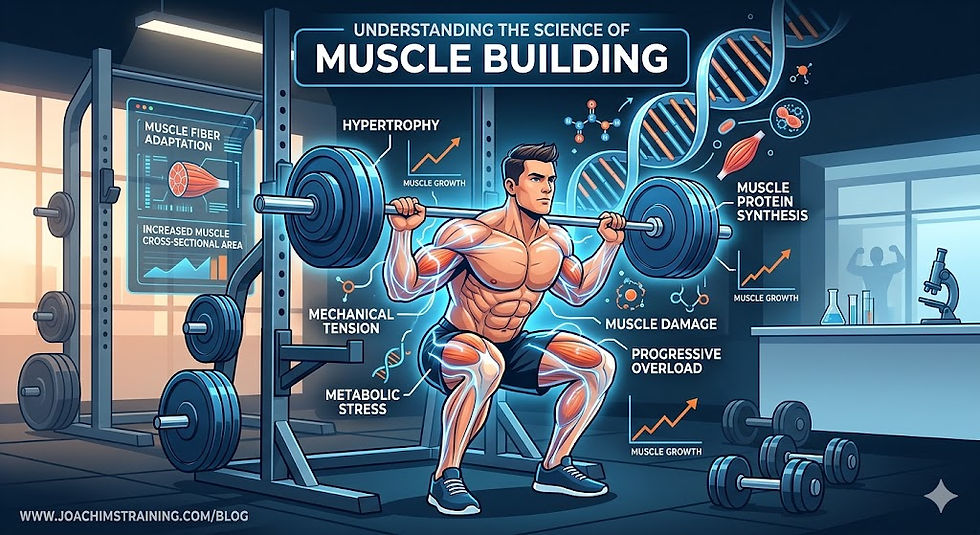
Every few months the internet discovers a brand new secret to building muscle. A novel split. A magic rep range. A powder that promises what a barbell already does for free. Then it quietly forgets that secret and discovers another one. Meanwhile the actual muscle building rules have barely moved in twenty years, because the science keeps landing on the same short, unglamorous list.
I want to walk through that list. Not the influencer version with the shirtless thumbnail and the countdown timer. The real one, the one I use with clients in their living rooms and building gyms across NYC. And where it matters, I am linking you straight to the research so you can check my work, because "trust me bro" is not a citation.
Much of this is anchored in a 2023 consensus review in Physiological Reviews written by fourteen of the leading muscle scientists alive, plus the brand new 2026 American College of Sports Medicine Position Stand, which chewed through 137 systematic reviews and more than 30,000 people. When that many serious researchers land in the same spot, it is worth shutting up and listening.
The Muscle Building Rules That Actually Matter
There are about 10 of them. None require a subscription or a fancy watch. They sort neatly into what you do in the gym, and what you do the other 23 hours of the day. The gym half is effort, tension, overload, volume, range of motion, and exercise selection. The other half is recovery, protein, sleep, and the willingness to keep doing the boring thing for years. That is the whole sport. Easy to understand but hard to do.
Effort And Tension Are King
The single biggest lever is how hard you do a exercise set, not how much is on the bar. It is all about effort. Push your working sets to failure or to within 1 to 3 reps of it. You can build muscle with weights that would embarrass a powerlifter, as long as you take the set close enough to failure. You just need more reps to get there. Personally I prefer 5-15 rep range....but every once in awhile I will shoot for 50 or 100!
Here is where people overcorrect. There is a stubborn gym myth that you must grind every set to the screaming, vein popping edge or you wasted your time. The evidence politely disagrees. A well run meta analysis on proximity to failure found at most a trivial advantage for going all the way to momentary failure versus stopping a rep or two short. Get close, bank the stimulus, and skip the recovery tax that comes with the last ugly grinding rep. Regulary training to failure is too much for most folks and may increase injury risks.
Effort without tension, though, is just cardio with a grimace. The load still has to be heavy enough to put real mechanical tension on the target muscle. No tension, no signal, no reason for the muscle to adapt. Muscle fiber grows largely in response to mechanical loading by building more of its own contractile machinery. This is also why isometric training earns its place. Holding a hard position is tension without much joint stress, which is useful when something hurts. Light and lazy does nothing. Light and close to failure works. Heavy and close to failure works. Lazy at any weight is a hobby, not a stimulus.
NOTE: For women worried about getting "too big": you will not, and this is the most stubborn myth in the gym. Women carry a fraction of the testosterone men do, and building muscle is slow even when everything is dialed in. What lifting actually does for most women is reshape the body, not enlarge it. Adding lean muscle mass tightens and shapes the exact areas everyone says they want shaped ('apple bottom' butts), while changing very little about your overall size in the mirror or in your clothes. The lean, athletic look people chase is muscle. The genuinely large physiques you are picturing take many more years, far more food, or illegal pharmacology that the women raising this concern are not using.
Volume, And Why You Are Probably Underdosed
Here is where people quietly sabotage themselves. Aim for at least 10 hard working sets per large muscle group per week. Cap it around 20. Past that you are not buying muscle, you are buying recovery debt and elaborate excuses. That range is where the bulk of the volume research lands.
The people convinced they are nonresponders, the ones who lift and lift and never change, are almost always just underdosed. When researchers took older adults who failed to respond to a low volume program and raised the volume, the response showed up. Same person, more sets, growth.
So if you have decided your genetics betrayed you, the likelier truth is that you are doing 4 hard sets a week for a muscle that wanted 10. Your genetics are probably fine. Your set count is the problem. And the genetic tests (23 and Me etc.) that claim to predict your "muscle response" are nowhere near ready for real use, so hang onto that money too.
Recovery, Range, And The Exercises You Actually Pick
You do not grow in the gym. You grow in the 36 to 72 hours after, while you eat, sleep, and leave the muscle alone. Give a muscle group roughly 36 hours minimum before you hammer it again. For most people, training each muscle about 2x a week is the sweet spot, which is exactly what the ACSM Position Stand recommends. 2x beats 1x. 6x does not beat 2x. It just digs a hole and hands you a shovel.
Train through the complete range of motion, and especially own the long lengthened, stretched position, which is where a large share of the growth signal appears to live. Half reps feel productive because the weight is heavier and the burn is loud. They are mostly ego. The Hornberger lab's work on how fibers actually grow suggests there is a real mechanistic reason to respect the stretch. Lengthen the muscle under load and control it. Your ego will survive and muscle will adapt.
As for which exercises, an exercise earns its spot only if 2 things are true. You can feel the target muscle working, and you can add reps or load over time without your joints filing a formal complaint. If you cannot feel it or cannot progress it, get rid of it. This is also where the machines versus free weights argument quietly dies in a corner. The evidence says the choice matters far less than the internet thinks. Both build muscle. I made the longer case for this in There Are No Bad Exercises. The best tool is the one you can progress on, not the one with the most aggressive marketing.
Which brings up the engine under all of it. A muscle adapts to a stress only if the stress keeps climbing. How you make it climb does not matter much....more reps, more sets, more weight, more time under tension, larger range of motion, cleaner technique etc. Pick a lever and nudge it over time. The mistake most people make is not choosing the wrong lever. It is never touching any lever at all. I know far too many people at the gym that stay with the same weights and routine for years. And then they wonder, how come I'm not getting stronger and more lean?? No progressive overload = no change.
Strength Versus Size
People lump strength and size together, and they overlap, but the dials are set differently.
Hypertrophy responds to volume and moderate loads taken close to failure across a wide rep range, anything from about 5 to 50 reps. Strength is more specific and more neural. It rewards heavier loads, lower reps in the 1 to 5 range, longer rest periods of 3 to 5 minutes, and more practice of the exact lift you want to get strong at.
If your goal is a bigger (heavier) squat, you must train the squat heavy and often. If your goal is bigger legs, you have far more freedom in exercise selection and rep range, and you can chase the pump on a leg press without guilt. Most general clients want some of both, which is why a sane program runs heavier strength work early in a session and higher rep hypertrophy work after. You are not choosing a religion. You are setting a dial.
The Boring Inputs: Protein, Sleep, And The Supplement Aisle
This is where most muscle building actually succeeds or fails, and it is the least photogenic part.
Protein intake should hit the same number every day, training day or not. Aim for about 1.6 to 2.2 g/kg of goal body weight, which, for Americans, is roughly 0.7 to 1 g per pound. Total daily protein matters far more than obsessing over timing windows. Hit the number, spread it across the day, and stop reading articles about the anabolic window. Oh, and don't forget the micronutrients and fiber in fruits and vegetables. These are important too. Lastly, eat enough total kcals. It's is extremely difficult building lean muscle mass in a caloric deficit.
Sleep is the cheapest legal anabolic there is: 7 to 9 hours seems to be the sweet spot. Most of your adaptation happens here, not under the bar. You can do everything else perfectly and quietly cancel half of it by sleeping 5 hours and calling yourself disciplined. Sleep is not the reward for the training. It is part of the training, the unglamorous horizontal part. It's much less painful than working out....I kind of sleep through it.
Supplements sit dead last. Of everything that influences how well you respond to training, they are the rounding error, not the strategy. Creatine monohydrate is the one cheap, well supported exception, and even that is a modest edge on top of the real work. If you want to squeeze out maybe another 3 to 5 percent on top of creatine, a hit of caffeine before training and a whey protein shake to help reach your daily protein number can both help a little. Neither moves the needle much. I ranked what is actually worth your money in my breakdown of the best supplements. Everything else in that aisle is selling you the idea that the boring inputs are negotiable. No, they are not.
Consistency Wins, And Age Is Not The Wall You Think It Is
This is the rule that quietly beats all the others. The best program is the one you actually keep doing. Chronological age is not the barrier people pretend it is either. Older adults build muscle just fine when the training is dosed and recovered properly, and resistance training is doing more for long term bone health and independence than any supplement or trend ever will.
Beginners overcomplicate, veterans get bored, and both go looking for something better when the thing they already had was working. Do the boring stuff. Progress something. Recover. Repeat for years. That beats every clever 12 week protocol on the internet, including the ones with a countdown timer.
Folks used to ask me all the time, "how do you look so fit?" Now I get the same question with the modifier...."at your age". I always give the same answer: Decades of working out consistently. I've been working out at least 3-5x per week for 40 years. Consistency beats intensity and perfection every time!
What To Actually Do
If you want the muscle building rules boiled down to a checklist, I got you:
Take your working sets to within 1 to 3 reps of failure. Close to failure is the whole game.
Use a load heavy enough to create real tension. Lighter weights still work if you take the set close enough to failure, you just have to do more reps.
Do 10 to 20 hard sets per large muscle group per week. Start near 10, add only if you are recovering and progressing, do not bother past 20.
Train each muscle group about 2x a week, leaving at least 36-42 hours between hard sessions for it. This also includes ab training.
Use a full range of motion and make sure you hit the long length stretched position.
Pick exercises you can feel and can add reps, sets or load to over time. If you can do neither, switch.
Progress something. More reps, load, sets, time under tension, or cleaner technique. Track it so you know.
Eat about 1.6 to 2.2 g/kg (.65 to 1g/lb) of goal body weight in protein every day and ignore most of the supplement aisle. And eat enough kcals; it's hard to build lean muscle in a calorie deficit.
Then keep showing up for years, especially on the cold rainy days in January when you do not feel like it.
Recover. Sleep 7-9 hrs every night.
For more health and fitness information or in-home personal training services in NYC please click here: www.joachimstraining.com, or contact me here: https://www.joachimstraining.com/contact-trainernyc.


Comments